A desk is the one distance your glasses were not made for
Distance lenses are ground for the road and reading lenses for a book. A monitor sits between the two, which is why so many people finish the day leaning in with their chin up.
There is a particular posture people adopt at a desk somewhere in their forties. Chin lifted slightly, head pushed forward, leaning in towards the monitor. It gets treated as a bad habit and corrected with reminders to sit up, which never work, because it is not a habit. It is somebody trying to find the part of the lens that is in focus.
Glasses are made for specific distances. A desk is usually not one of them.
Three distances, two prescriptions
Vision correction is generally written for far or for near. Far means the road, a room, a lecture theatre, effectively infinity. Near means a book, at around forty centimetres.
A monitor sits at roughly fifty to seventy centimetres. That is intermediate, and it is nobody's default. Under about forty a single-vision distance prescription covers it well enough, because the eye can still adjust the remaining amount by itself. That ability is exactly what fades.
What changes after about forty
The lens inside the eye stiffens gradually from childhood, and somewhere in the mid forties the range left over stops reaching arm's length. This is presbyopia, it happens to everybody, and it is the reason reading glasses exist.
Reading glasses are set for a book. Put a pair on at a monitor sixty centimetres away and the screen is very slightly soft, so you lean in until it is not, which brings your head forward, which is precisely the position every article about neck pain tells you to avoid. In this case the neck is the symptom and the prescription is the cause.
Progressive lenses and the raised chin
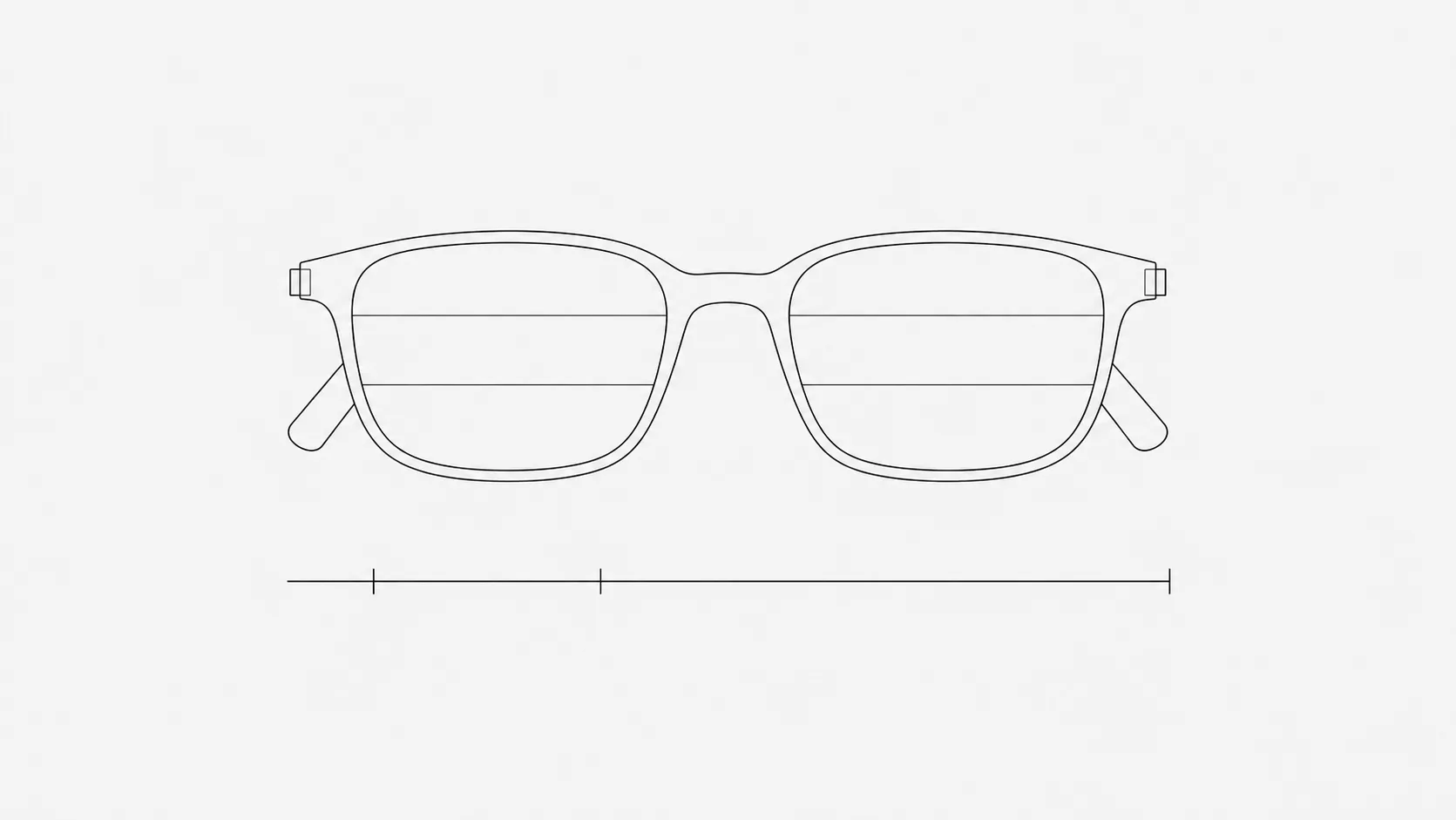
Progressive lenses solve the two-distance problem with a gradient down the lens: distance at the top, intermediate through the middle, reading at the bottom. It is an elegant answer and it works well for most of life.
At a desk it has one specific failure. The intermediate section is a narrow corridor low in the lens, so to see a monitor through it you have to look through the lower part of the lens while facing straight ahead, which means tipping your head back. Studies that measure head position at computers find progressive wearers sitting with more head extension than single-vision wearers, and find it comes back down when the lens is swapped for one designed around near and intermediate work.
If you wear progressives and your neck aches at a desk, drop the monitor ten centimetres before you change anything else. Working out whether the glasses are driving your head position takes about a day of paying attention to it.
The prescriptions nobody bothers to correct
Small amounts of long-sightedness and small amounts of astigmatism often go uncorrected, because distance vision tests fine and nothing looks obviously blurry. Blur was never the complaint they produce. The complaint is that reading is tiring, and that the tiredness arrives after an hour rather than immediately.
An eye can compensate for a small error by working continuously to do it. That is free for twenty minutes and expensive across a working day. It turns up as aching, heavy eyes, a dull pressure behind the brow, and words that shift slightly at the end of the afternoon. People describe it as eye strain and go hunting through their display settings.
This is worth saying plainly because a first proper eye test in adulthood is an extremely boring suggestion with an unusually high hit rate. A lot of people who have been fighting their screens for years turn out to have a small correction nobody ever gave them.
Occupational lenses, and what to ask for
There is a category of lens made for exactly this, sold variously as occupational, office or degressive lenses. They give up distance vision entirely and spend the whole lens on the range from about a metre in to reading, which turns the intermediate zone from a corridor into most of the lens.
You cannot drive in them. You can see a whole monitor without moving your head, which at a desk is worth considerably more. Most people who work at a screen all day and wear progressives are better off owning both, and most have never been offered the choice, because the appointment never got round to what they do for eight hours a day.
Coatings help, tints mostly do not
- Anti-reflective coating is the one with a plain physical rationale. It cuts the reflections of the room off the front and back surfaces of the lens, which are a real source of glare and get worse in a bright office.
- Blue-light filtering has been reviewed and did not show a benefit for eye strain. It remains the most heavily sold feature in the category, by a distance.
- A slightly weaker reading addition is sometimes prescribed specifically for screen distance. Ask about it rather than assuming your reading pair already covers it.
- Clean them. Unremarkable advice with a measurable effect, and the average pair of desk glasses is filthy.
Before your next eye test
Take numbers, not descriptions
- Measure from your eyes to your screen. A tape measure, once, sitting the way you actually sit. This is the single most useful thing you can walk in with.
- Measure the screen height too, along with the distance to anything else you look at often, like a second monitor or a document beside the keyboard.
- Say what you do all day. Eight hours at sixty centimetres changes what gets prescribed. Fine, thanks does not.
- Describe the symptoms by their shape. When they start, how long they last, whether they are worse by the end of the day, whether closing one eye helps.
- Ask specifically about an occupational lens if you wear progressives and work at a screen.
Sudden changes in vision, double vision, flashes, a shower of new floaters, eye pain rather than eye tiredness, or headaches that wake you are not desk problems. Those need looking at promptly rather than at the next routine appointment.
The short version
A monitor sits at a distance neither a driving prescription nor a reading prescription was made for. Under forty your eyes cover the gap themselves. After that they do not, and the result looks exactly like bad posture: leaning in to find focus, or tipping the chin up to find the intermediate corridor of a progressive lens. Measure the distance from your eyes to your screen, take that number to an eye test, and ask about a lens built for it. It resolves more desk neck ache than a new chair does, and almost nobody tries it.