Your head does not weigh 27 kilos when you look down
The number comes from a computer model, not a scale. The fixation on head angle has buried the thing that actually predicts whether your neck hurts by 5pm.
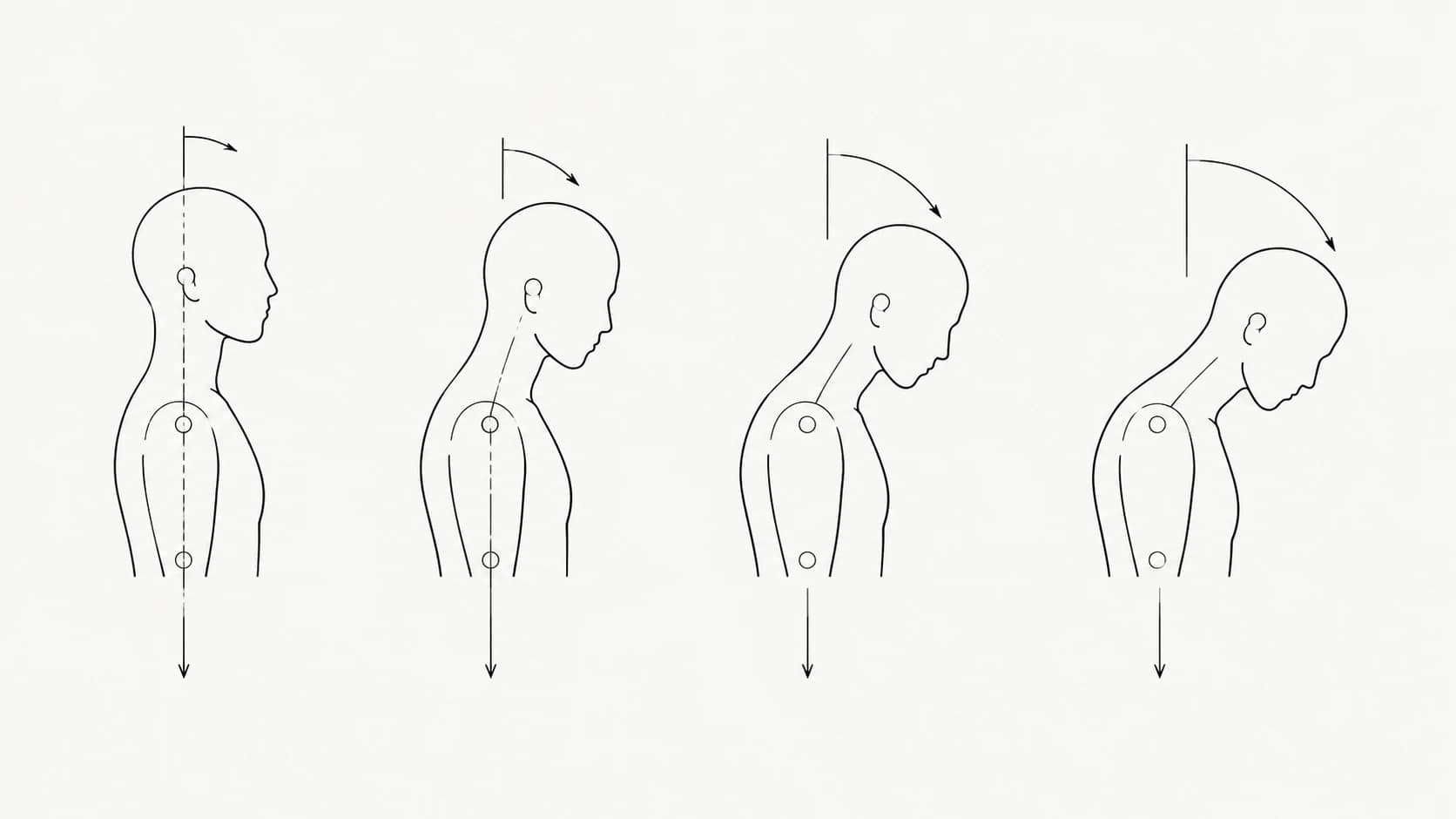
You have seen the graphic. A head tilted forward at increasing angles, with a weight printed beside each one. Five kilos upright. Eighteen at thirty degrees. Twenty-seven kilos at sixty, usually next to a line about how that is the weight of an eight-year-old hanging from your neck.
It gets repeated by physiotherapists, posture apps and morning television. It is not made up. It is also not what most people think it is, and the misunderstanding has sent a lot of people chasing the wrong fix.
Where the number came from
A 2014 paper by a New York spine surgeon calculated the forces on the cervical spine at different head angles. The figures are real outputs of that calculation: roughly 5 kg with the head upright, rising to about 27 kg at sixty degrees of flexion.
The critical detail, left out of nearly every retelling, is that nobody measured anything. It was a computer model. No scale, no sensor, no person. The model treats the head as a weight on a lever and works out the torque, which is a perfectly reasonable thing to do and tells you something true: the further forward your head goes, the harder the muscles at the back of your neck have to pull.
What it does not tell you is how long anyone holds that angle, whether the load is shared with other tissues, or whether the people with the worst angles are the ones in pain. A static snapshot cannot answer any of that, because it has no time axis at all.
The part that got lost
If forward head posture caused neck pain in a straightforward way, the people with the most forward heads would hurt the most. Researchers have looked for that relationship repeatedly, and it keeps coming back weaker than the graphic implies. Several reviews of adults have found no reliable association between measured head position and whether someone has neck pain. Studies in teenagers, the group the phrase text neck was coined for, have often found the same nothing.
This is genuinely awkward for anyone selling posture correction, so it tends to go unmentioned. It is worth saying plainly: the angle of your head, measured once, is a poor predictor of whether your neck hurts.
None of this means posture is irrelevant. It means a single snapshot of posture is close to meaningless. The two claims get confused constantly, usually by people arguing that because the graphic is wrong, sitting however you like for nine hours must be fine.
What does predict a sore neck
The factors that hold up are duller than a diagram of a tilted head, and they have one thing in common.
- How long you hold one position. Sustained static load is the recurring finding. Muscles held at low effort for a long time fatigue in a way that brief high effort does not, and the small stabilising fibres in your neck get recruited first and released last.
- How little you vary it. Two people can average the same head angle across a day, one by holding it constantly and one by moving through a range. Their necks do not feel the same at 5pm.
- Whether you are under pressure. Deadline stress raises baseline muscle tone in the neck and shoulders. It is one of the more consistent findings in the office-pain literature and one of the least convenient.
- Sleep and general activity. Both change how much load your tissues tolerate before complaining. Neither has anything to do with your monitor.
Notice that three of the four are about time rather than geometry. That is the actual lesson of the 27 kilo figure, and it is the opposite of the one usually drawn from it. A moderate angle held rigidly for two hours is worse than a bad angle you keep leaving.
Why your head goes forward in the first place
Almost nobody starts the day with their head jutting forward. It arrives gradually, and it is nearly always a symptom of something else.
| What you notice | What is usually causing it |
|---|---|
| Head creeping forward mid-afternoon | Text too small, or a screen slightly too far away. You are moving your eyes closer rather than fixing the cause. |
| Chin lifting, neck compressed at the back | Screen too high, or varifocals being used through the reading section. |
| Shoulders rising toward your ears | Desk or armrests too high, mouse too far to the side, or plain tension. |
| Neck fine in the morning, sore after lunch | Nothing about your geometry. That is duration. |
The last row is the common one, and it is the one no amount of desk measuring will fix.
What to actually do
In order of how much they matter
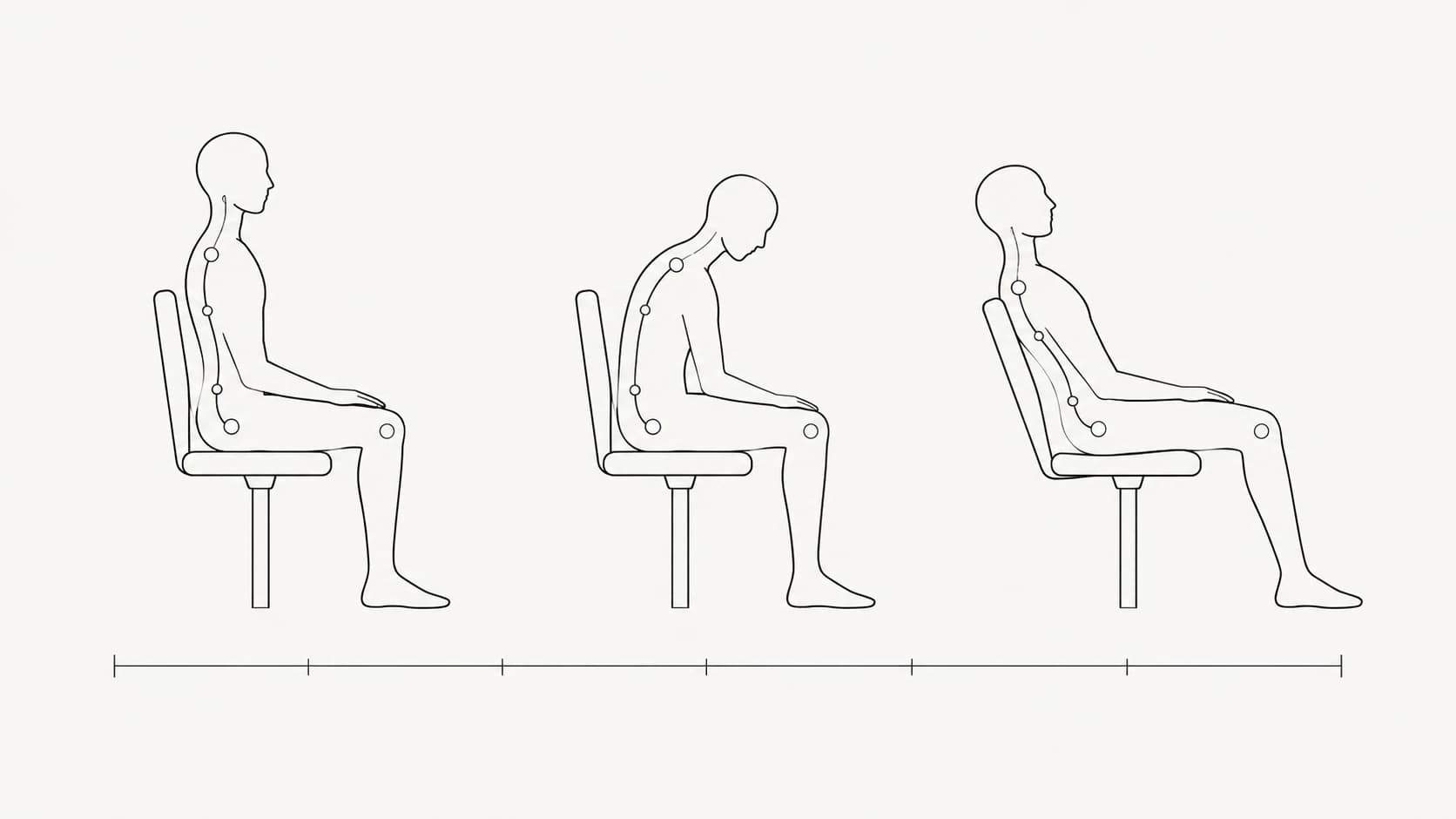
- Change position often. Not correctly. Often. If you take one thing from this, take that the best posture is the next one.
- Raise your screen until the top of it is roughly at eye height. This removes the reason your chin drops, rather than asking you to resist it.
- Increase your text size before you increase your lean. Most forward drift is a vision problem wearing a posture costume.
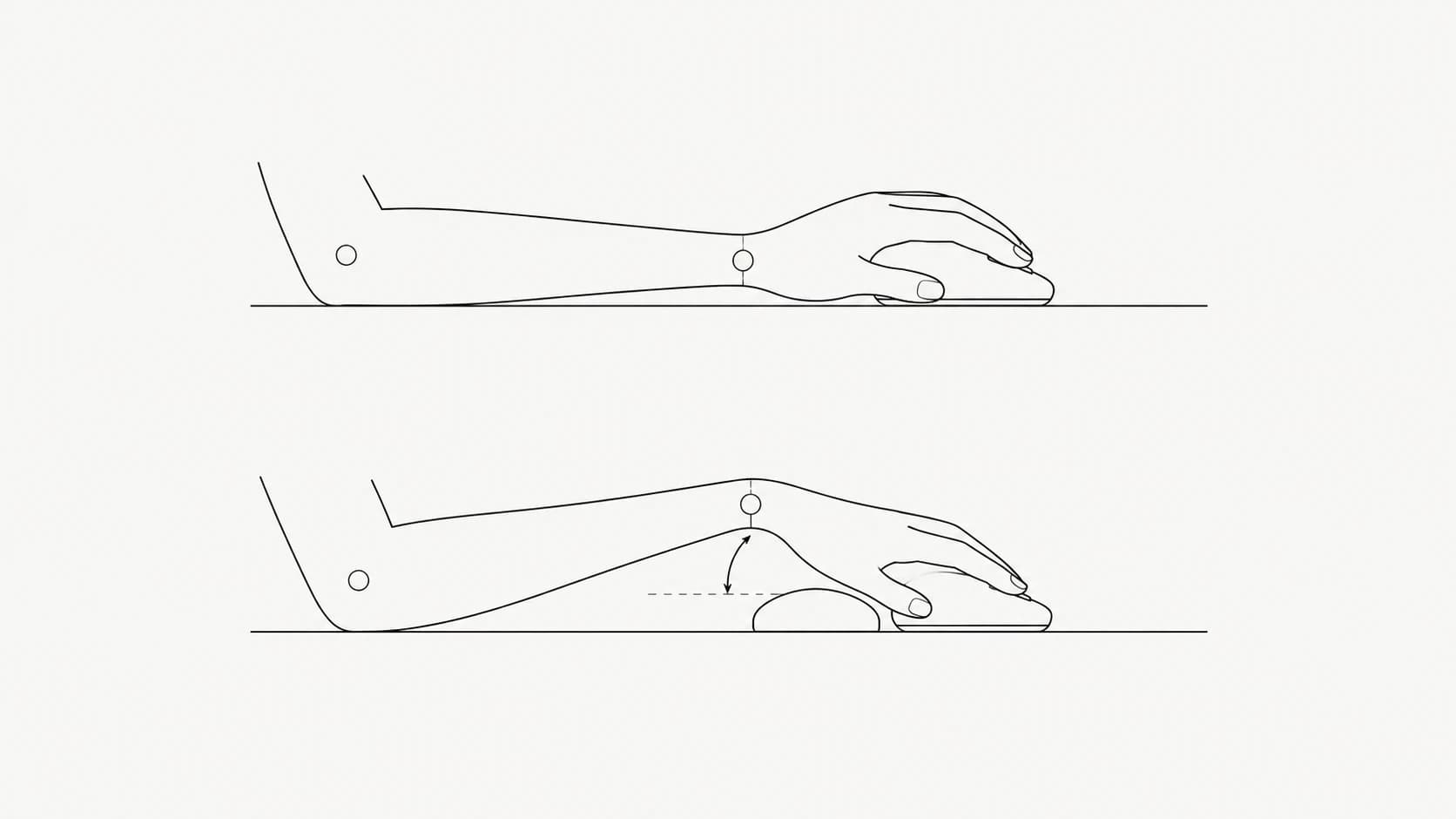
- Get your mouse closer to your body. A mouse parked out to the side loads your shoulder continuously, and the neck follows the shoulder.
- Stand up every twenty to thirty minutes, even for ten seconds. This is the intervention with the least glamour and the most support.
What is not worth your money
Posture braces are the clearest example. They hold you in a position rather than teaching you anything, which means they do the work your muscles would otherwise be doing, and the effect disappears the moment the brace does. There is no good evidence they change resting posture.
Neck-specific stretching feels excellent and helps for roughly as long as it takes to sit back down. Do it if you enjoy it. Do not expect it to substitute for moving during the four hours in between.
When it is not the desk
Most desk neck pain is an aching, one-sided, gets-worse-through-the-day complaint that eases overnight. That pattern is boring and reassuring.
Pain that shoots down an arm, numbness, pins and needles, weakness in a hand, or neck pain that wakes you at night is a different question and worth taking to a clinician rather than a blog. The same goes for anything that follows a fall or a crash.
The short version
Your head does not gain 22 kilos when you look at your phone. The load does go up, the model was not wrong about that, and it was never measured on a person. The thing that decides how your neck feels at the end of a day is not the angle you hold. It is that you held one at all, for hours, without noticing.