Your wrist rest is probably making it worse
Wrist pain from a mouse usually starts at the shoulder, and the pad sold to fix it holds your hand in the position that causes the problem.
The pain arrives somewhere between the base of the thumb and the top of the forearm. It is worse on heavy mouse days, it eases at the weekend, and the first thing almost everyone buys is a gel pad to put under the wrist.
That pad is doing something, and it is often not what you want.
What a wrist rest actually does
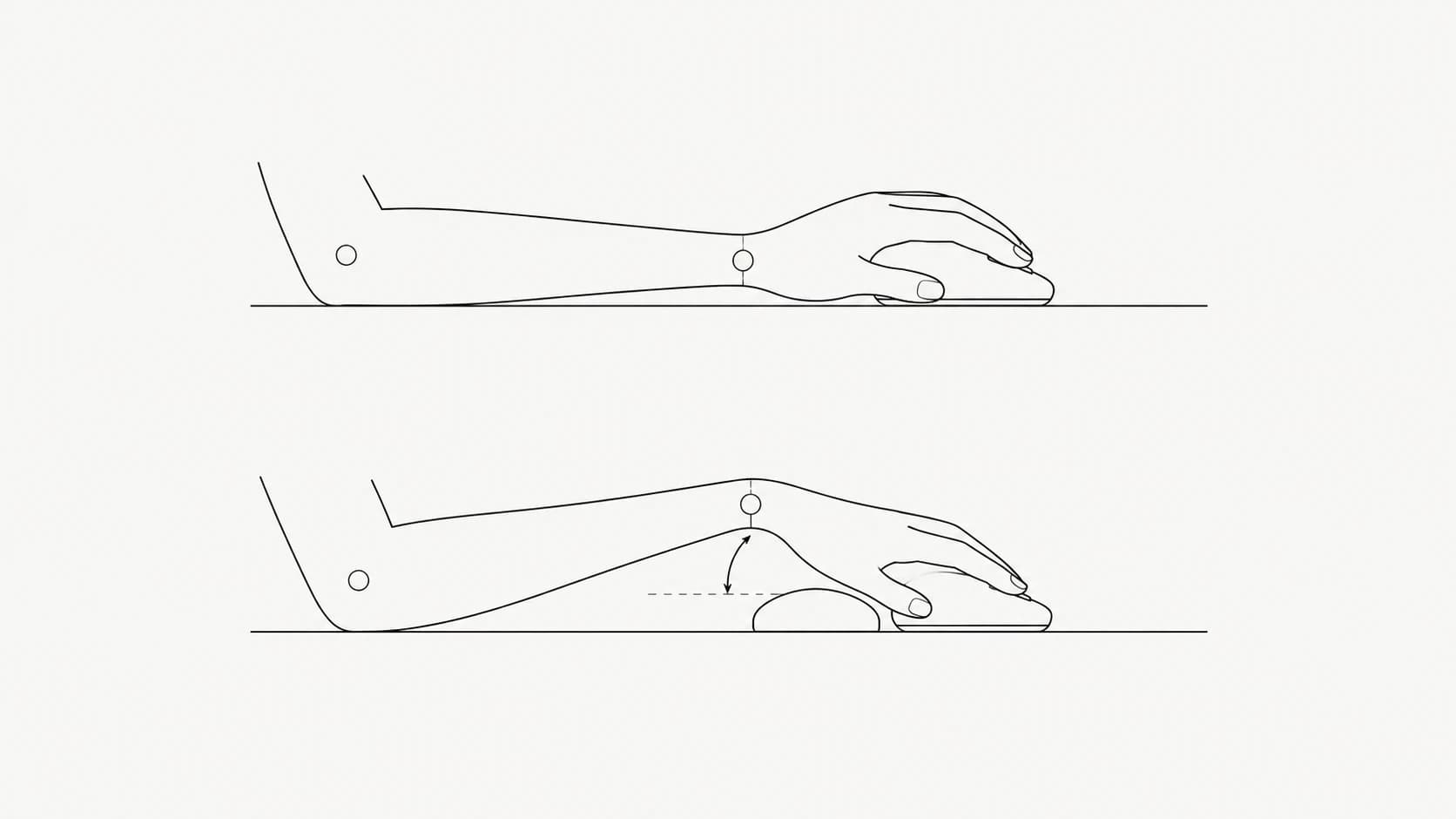
Resting your wrist on a pad and then moving the mouse anchors your hand at one point and makes everything else pivot around it. Two things follow.
Your wrist bends backward. With the heel of the hand raised and the fingers on a mouse, the joint sits in extension. Pressure inside the carpal tunnel is lowest when the wrist is straight and rises as it bends in either direction. You have chosen to hold it bent for the whole day.
You move from the wrist instead of the arm. Anchored, you steer the mouse with small deviations of the joint, thousands of times. Unanchored, the whole forearm slides and the wrist stays neutral.
Wrist rests are named badly. They are for resting on between bursts of work, not for leaning on while working. Used that way they are fine. Almost nobody uses them that way.
It usually starts further up
Watch where your mouse sits. On most desks it is parked out to the right of the keyboard, past the number pad, which puts your upper arm away from your body for eight hours.
Holding your arm out to the side is low-effort and completely sustained, which is the combination muscles handle worst. The shoulder fatigues, you brace the forearm to compensate, and the symptom shows up at the wrist because that is where the tendons are thinnest and most crowded. The wrist is where you feel it, not where it began.
The test
- Sit normally and let both arms hang. Now reach for your mouse without moving your torso.
- If your elbow travels away from your ribs, your mouse is too far out. That is the single most common cause of desk arm pain.
- A full-size keyboard is usually the culprit. The number pad pushes the mouse fifteen to twenty centimetres further right than it needs to be.
About carpal tunnel
Worth being accurate, because the phrase gets used for any hand pain. Carpal tunnel syndrome is a specific thing: the median nerve is compressed at the wrist, and it produces numbness and tingling in the thumb, index, middle and half the ring finger. Classically it wakes people at night and they shake the hand to relieve it.
The link between ordinary computer work and carpal tunnel is far weaker than the internet suggests. Reviews looking at office workers have repeatedly failed to find the strong relationship everyone assumes, and the occupations with the clearest risk involve force and vibration rather than typing.
Which is mostly good news. Most desk hand pain is tendon and muscle irritation from sustained position, and that responds well to changing the position.
What to change, in order
| Change | Why it works | Cost |
|---|---|---|
| Move the mouse closer to the keyboard | Brings the upper arm back to your side and unloads the shoulder | Free |
| Stop resting the wrist while moving | Lets the forearm slide, keeps the joint neutral | Free |
| Lower the mouse sensitivity fight | Higher sensitivity means smaller movements, so less travel per hour. Most people run theirs too low | Free |
| Switch to a keyboard without a number pad | Removes the reason the mouse sits far right | Cheap |
| Try a vertical mouse | Puts the forearm in a handshake position instead of rotated flat, which is its neutral | Moderate |
| Trackball or trackpad | Removes arm travel almost entirely. Worth trying if pain follows movement rather than posture | Moderate |
Work down that list rather than jumping to the bottom of it. The free changes fix a surprising share of cases, and buying a vertical mouse while still parking it out past the number pad changes very little.
The elbow one nobody mentions
If the pain is on the outside of your elbow rather than the wrist, look at desk height. A desk that is slightly too high makes you lift your forearms, and the muscles that extend the wrist attach right there. It gets called tennis elbow by people who have never held a racket.
Your forearms should rest roughly level with the desk, elbows near your sides and bent a bit past ninety degrees. If your shoulders are creeping upward, the desk is too high or the chair too low.
When to stop reading and get it looked at
Numbness or tingling in specific fingers, especially at night. Weakness, dropping things, or losing grip. Pain that no longer settles overnight or at weekends. Any of those is worth a clinician rather than another gadget, and early is much better than after a year of it.
The short version
Bring the mouse in toward your body, stop pinning your wrist to a pad while you move it, and let the whole forearm do the travelling. Those three cost nothing, address the actual mechanism, and between them they resolve most desk hand pain before anyone needs to buy anything shaped like a joystick.