The eight glasses rule was never a rule
It appears to come from a 1945 sentence that also said most of it comes from food. What matters at a desk is not the total anyway. It is that you stopped noticing.
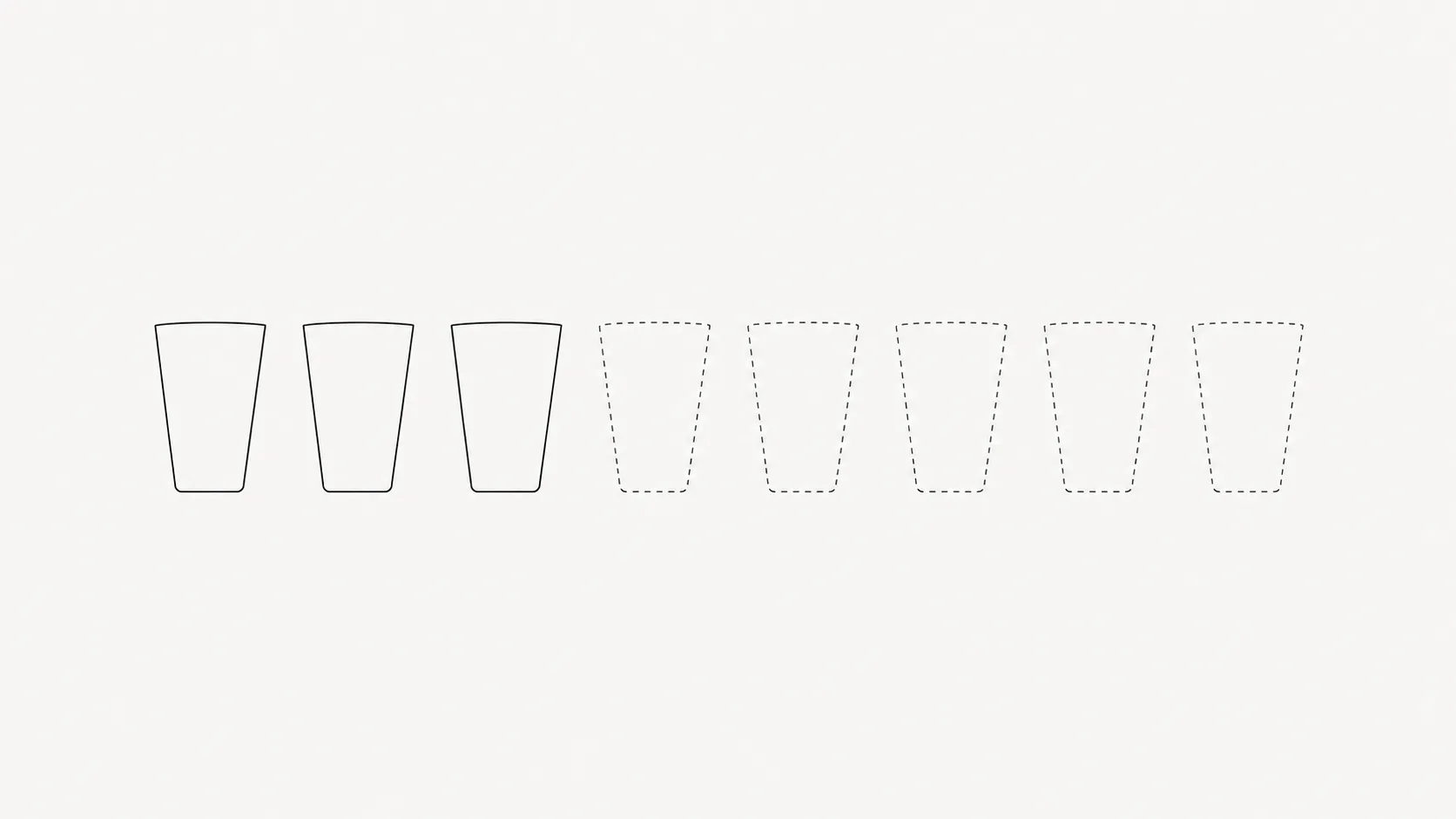
Eight glasses a day. Two litres. Half your body weight in ounces, if you grew up somewhere that measures water in ounces. Everyone knows the number, nobody remembers where it came from, and there is a whole shelf of marked bottles built on it.
The number is not exactly wrong. It is just far more arbitrary than it sounds, and treating it as a target distracts from something that genuinely does go wrong at a desk.
Where the number seems to come from
The usual trail leads to a 1945 recommendation from the US Food and Nutrition Board, which suggested something like 2.5 litres of water a day for adults. That is roughly eight glasses, so far so good.
The next sentence is the one that got lost. It noted that most of this quantity is contained in prepared foods. Fruit, vegetables, soup, bread, coffee, tea, milk, all of it counts. The recommendation was for total water intake, not for water you pour into a glass, and somewhere between 20 and 30 percent of it typically arrives on a plate.
Modern guidance is not a single number either. European and US bodies land somewhere around 2 to 2.5 litres of total water a day for men and 1.6 to 2 for women, explicitly including food and all drinks, and explicitly noting that requirements vary enormously with heat, activity and body size.
The claims that did not survive testing
Several familiar beliefs about water have been looked at properly, and they hold up poorly.
- Coffee and tea do not dehydrate you. Caffeine is a mild diuretic, and at habitual doses the fluid in the cup more than covers what it costs. Moderate coffee intake hydrates you about as well as water does.
- Thirst is not too late. The idea that feeling thirsty means you are already dangerously dehydrated is repeated constantly and has no good support in healthy adults. Thirst is a functioning system, not a broken alarm.
- Drinking more water does not reliably help skin, weight, or concentration in people who were not short of it. The studies showing cognitive effects are mostly in people who were genuinely dehydrated, often deliberately so.
- More is not automatically better. Drinking far beyond thirst dilutes blood sodium. It is rare, it mostly affects endurance athletes, and it is genuinely dangerous.
So what actually goes wrong at a desk
Not your hydration target. Your attention. Deep work suppresses the small interruptions that would otherwise make you drink, and thirst is one of the easiest signals to override when you are concentrating.
The result is not usually dehydration in any clinical sense. It is a four-hour stretch in which you noticed nothing at all, drank nothing, moved nothing, and stood up at one o'clock stiff, foggy and vaguely irritable. People reach for the water bottle to explain that feeling because it is the most visible thing missing.
| What you notice at 3pm | What is usually behind it |
|---|---|
| Dry mouth, mild headache | Genuinely worth a glass of water. This one is real and easy. |
| Foggy, slow, rereading the same line | Time on task and no break. Water helps because you stood up to get it. |
| Stiff neck and shoulders | Four hours in one position. No amount of water addresses this. |
| Tired but wired | Caffeine timing and a skipped lunch, not fluid. |
The second row is the interesting one. A glass of water at three in the afternoon does often help, and frequently not for the reason people assume. Going to get it means standing up, walking, looking at something more than a metre away and thinking about nothing for ninety seconds. That is a break wearing a glass of water as a disguise.
A better way to judge it
Urine colour is imperfect but far more useful than counting glasses, because it responds to your actual situation rather than an average of everyone's.
Roughly, and without becoming strange about it
- Pale straw is fine. That is the target, not clear.
- Completely clear, very often usually means you are drinking more than you need. Harmless in most people, mildly annoying in meetings.
- Dark, with few trips to the bathroom, is worth a glass or two. This is the one that actually indicates something.
- First thing in the morning is darker for everyone. Do not diagnose yourself at 7am.
- B vitamins turn it bright yellow and tell you nothing about hydration at all.
What to actually do
Keep water within reach, because effort is the only real barrier. Drink when you are thirsty, and drink a bit more in heat, after exercise, or when you have been talking all day. Let food and coffee count, because they do.
Then treat the reminder as what it really is. A prompt every hour or two is not correcting a fluid deficit. It is a small, low-guilt reason to stop, stand up and change position, which is the thing that was actually missing from your morning. If the water is the excuse your body needs to move, that is a good enough reason to keep the bottle on the desk.
When it is worth more attention
Constant thirst that drinking does not settle, needing to urinate through the night, sudden changes in how much you produce, or thirst alongside unexplained weight loss are all worth a doctor rather than a bigger bottle. Older adults have a genuinely blunted thirst signal, and some medications change fluid balance, so the advice to trust thirst is not universal.
The short version
Eight glasses came from a recommendation that also said most of it arrives in your food, and it was never a rule. You do not need to hit a number. What you need is water within arm's reach, thirst you actually respond to, and a reason to stand up every so often. The bottle on your desk is doing its best work when it gets you out of the chair.